Follow-up from Week 1:
Here is the corrected link that didn't "work" last week, and if you click on "Chapter 1" at the bottom of this index page, and then in Chapter 1 you click on the little "AIFF" icons, you can hear an exellent audio example of his point...
A link to Dr Fields' How-To pages
We ran out of time for any quotes from these books, so I'll list them again in hopes that today we'll touch upon them:
(a few quotes from the book Musicophilia: Tales of Music and the Brain by Oliver Sacks)
(a few quotes from the book The Muse That Sings: Composers Speak About the Creative Process by Ann McCutchan, available in the UNCA library)
(also a third book Psychology for Musicians by Lehmann, Sloboda, and Woody, also available in the UNCA library)
Last week we compared "creativity" in literature, visual art, and music. We heard computer-generated "Chopin-like" and "Joplin-like" examples. We saw some examples of computer software as might relate to composing, knowing that notation per se is not necessarily required for "composition," but that programs have been designed now to make musical notation similar to word processing in ease of entry/ correction/ etc. Also noted that programs with playback allow composers to "sit back and listen" to works in progress. Noted that I had posted some "philosophical questions" (and though we haven't really attended to them in class time yet, I'm willing to use class for discussion if students so desire?). Noted that the internet offers bottomless music-composition-related sites, and YouTube includes amazing "How To" videos as well (including the tension/release example we watched).
After break, we gathered at the piano and began considering the "Elements" (listed back on Class 1 page) in terms of patterns, patterns of modes and scales, patterns of chords... We saw how easily a "medieval chant" could be constructed, and how pleasurably a non-dissonant pattern such as the "pentatonic scale" could yeild instant improvisations. We were in the process of playing with word-derived rhythmic patterns when time was up.
Today, I hope to follow-up on scale and chord patterns and on those rhythms, after break, as well as exploring the earliest forms of historical "polyphony.".
I also hope to set up the optional "Composition Assignment" for anyone who wants to work on it (outside of class time) over the next two weeks...
But we begin, today, with
There are ENDLESS interesting online quotes and writings by composers about composing, in all genres. Here are just a few that happened to strike me, as I was wandering around online this week, and I encourage you to always go to YouTube and type in composers' names to hear and see performances of their music (keeping in mind that any single example is unlikely to fairly represent the composer's over-all style and output of course) if it doesn't already "play in your head" when you see their names like this:
- "The worst thing you can do is censor yourself as the pencil hits the paper. You must not edit until you get it all on paper. If you can put everything down, stream-of-consciousness, you'll do yourself a service." (click to wikipedia) Stephen Sondheim (1930- )
- "My sole inspiration is a telephone call from a director." Cole Porter (1893-1964)
- "The key to the mystery of a great artist is that for reasons unknown, he will give away his energies and his life just to make sure that one note follows another..." Leonard Berstein (1918-1990)
- "To achieve great things, two things are needed; a plan, and not quite enough time." Leonard Bernstein
- "I knew I was going to be composing. It all makes sense in retrospect. But you don't know while you're in the process of improvising your life." William Bolcom (1938- )
- "So much of what we do is ephemeral and quickly forgotten, even by ourselves, so it's gratifying to have something you have done linger in people's memories." John Williams (1932- )
- "Music is essentially built upon primitive memory structures." Morton Feldman (1926-1987)
- "Earlier in my life there seemed to be unlimited possibilities, but my mind was closed. Now, years later and with an open mind, possibilities no longer interest me. I seem content to be continually rearranging the same furniture in the same room. My concern at times is nothing more than establishing a series of practical conditions that will enable me to work. For years I said if I could only find a comfortable chair I would rival Mozart." Morton Feldman
(Feldman is probably the most obscure of today's quoted people, and there's little of his work on YouTube yet, but if you want to read a very "composer-ly" article ABOUT his music: achingly beautifully-written article)
- "I put together the influences of my life in as clear a way as I possibly can, in the same way that Beethoven or Schoenberg or Bach put their influences together." John Zorn (1953- )
- "That was my challenge as a composer. Like with anything, to keep yourself interested in doing what you do, you set yourself challenges. So I said, Okay, I'll try to write a hundred tunes in a year." John Zorn
- "I'm getting ready to write a piece now, and it's been six months thinking about it, changing the instrumentation, changing the name, doing more reading." John Zorn
- "Somebody said to me, 'But the Beatles were anti-materialistic.' That's a huge myth. John and I literally used to sit down and say, 'Now, let's write a swimming pool.' Paul McCartney (1942- )
(McCartney's online biography charmingly reports that "One of McCartney's greatest songs, covered by a record number of artists, is the poignant ballad "Yesterday." McCartney conceived the melody in a dream, (coupled with the lyric "Scrambled Eggs / Oh my darling you've got lovely legs") and was not sure for some time that it was original.")
Ah but enough of wondering whether one's dreamed "scrambled eggs" song is or is not original - Today we begin a two-week peek at a few compositional turning points in western music history... If such a quick peek at history excites you, then of course I encourage you to pursue more music history on your own, the internet resources are fabulous, and the UNCA library holds a nice collection of music history books as well.
Today we'll skim through "Early Music" (that is, up until about 1600), and then next week we'll skim through everything since 1600!
MIDDLE AGES
Wikipedia's Medieval Music articleAs was mentioned in our first class, early NOTATED music tended to be chant, which involved no strong rhythmic choices (rather just a "this note follows that note" breath-based succession).
Medieval chants, which were notated and kept carefully by the Roman Catholic Church, were all hand-scribed of course (no "printing" yet), almost all completely anonymous (as was most of the art and architecture of the middle ages), and comprised of settings of brief standard liturgical texts in Latin, each unrelated to the others (so a church service might include randomly-selected Kyrie, Agnus Dei, etc).
One of the few named composers is Hildegard, a twelfth century nun. In the days when the spinning wheel hadn't even been invented yet, and she would write in her journal that she'd been distracted by the loud noise of a single bumble bee, Hildegard made remarkable works in myriad genres (visionary visual art, literature, medicine, music, and the longest known "musical" for centuries to come - Ordo Virtutum) and she signed her name to her works. Her manuscripts miraculously have survived a millenium and are extant in museums today, with considerable online coverage also, now.
Her significance for this class - compositionally - is to remind us that a single line of unmetered melody (with or without drone) can be a powerful thing, in and of itself.
Wikipedia article YouTube example, solo voice with strummed dronePre-"instrumentation," pre-meter, pre-chord-progression... The visual art of the middle ages may offer some analogies, looking back from our current vantage point: pre-shadow, pre-perspective, would probably be classed as "primitive" if produced now, but often quite moving nonetheless.
Meanwhile rhythmic music for popular dancing and fun was obviously also being made (we have "iconic" evidence - paintings and so forth), but seldom "notated." It took centuries of collective thought to settle on a notational system that could depict both pitch and rhythms - though of course the IMPROVISATION and AURAL TRANSMISSION of such music could certainly happen (then as now) without the music ever being notated.
Once rhythmic notation reached the point where several different things could be rhythmically organized together at once, and performed FROM THE NOTATION without needing "heard performance" as the means of transmission, medieval musicians enjoyed a frenzy of (still only hand-written, but now with vernacular as well as Latin texts) MONOPHONIC (singer/songwriter jongleurs, troubadours and trouveres) and POLYPHONIC (multiple melodic lines interweaving, sacred or secular) music, with interesting SYNCOPATIONS made possible by now having MEASURES of rhythmically-steady music to "play against."
We will create something somewhat representative of this, after break today.
Meanwhile, the first composer known to purposefully set out to "make a name for himself" was Machaut, a fourteenth century "Ars Nova" (New Art) entrepreneur who personally hand-delivered fancy hand-made copies of his music to the nobles, in hopes of creating job security for himself as a composer. And he succeeded! Although he did have to deal with unusual challenges, such as being on the battlefield with his then-employer King John who unfortunately was slain in the battle, necessitating an unexpected renewed wave of marketing on Machaut's part, in search of the next supportive noble!
To be a composer in Machaut's times, you had to be able to handle the recently-standardized notational system, the choices of meter and of individual rhythms, the choices of pitch, and text-setting (since notated music was largely vocal, though general instrumental pieces were also made, to be played by whatever instruments were available in the ranges needed, since instruments were home-made and not quite stabdardized yet). As you can see, that is quite an increase from the skills required to compose chant.
A composer might be expected to compose both
- pop music in the vernacular (settings of poetry for solo singing with or without accompaniment by instruments such as lute, or settings of multiple playful texts for small-group polyphonic pleasure. Note that there's still no sense of "concert hall" or "chorus" or any large ensembles, since music was performed in dining halls during meals, in fields during festivals, in chambers, for fun among friends, etc), and
- liturgical works in Latin (and Machaut is famous for having composed a cohesive setting of all the Ordinary segments of the Mass, so that rather than pulling out unrelated Kyrie, Agnus Dei, etc for the service, the concept of a multi-sectional cohesive composition was introduced).
Either way, if you could juggle two or three individual melodic lines, you were a Machaut-like composer.
Machaut, and click on the "recommended music" example
an Ars Nova (not specifically Machaut) example of the look of music notation
His significance for this class is as an early example of the (then culturally dominant) concept of equally-interesting individual lines of melody, interweaving in a horizontally-conceived (as opposed to vertical chord-stacking) way. It's sometimes called "counterpoint" or "countermelody," as well as "polyphony," but whatever you choose to call it, the idea is for us as composers today to be encouraged to transcend the tyranny of the simple "chord plus one melodic line," found in so much music, and consider adding "horizontal" interest...
RENAISSANCE
The Renaissance was arguably the very best time for musical composition and for composers, since music permeated daily life, and there were great demands for freshly composed music both pop and liturgical, for every feast and event from weddings to coronations.
As the humanist idea of "literacy" caught on, education included MUSICAL literacy! Most who could read, could also read music. Music was regularly performed in households and courts for the pure social pleasure of it.
Needless to say, the market for composers BOOMED. No "starving artists" among capable composers. In fact, composers were "traded" amongst the nobility much as sports heroes are traded amongst cities today! Competent composers could easily become employed in very elegant and comfortable situations. Free-lance composers could count on constant offers of substantial commissions, to fulfill the constant need for fresh music. Keep in mind that not only were there not "standard pieces" yet (such as the now-standard Wedding March) to be replayed, nor of course electronic recordings to be played. A time of cultural expectation of fresh music, and the quantity and quality of live freshly composed music was as crucial to the success of any social event as the food and the other entertainments might be.
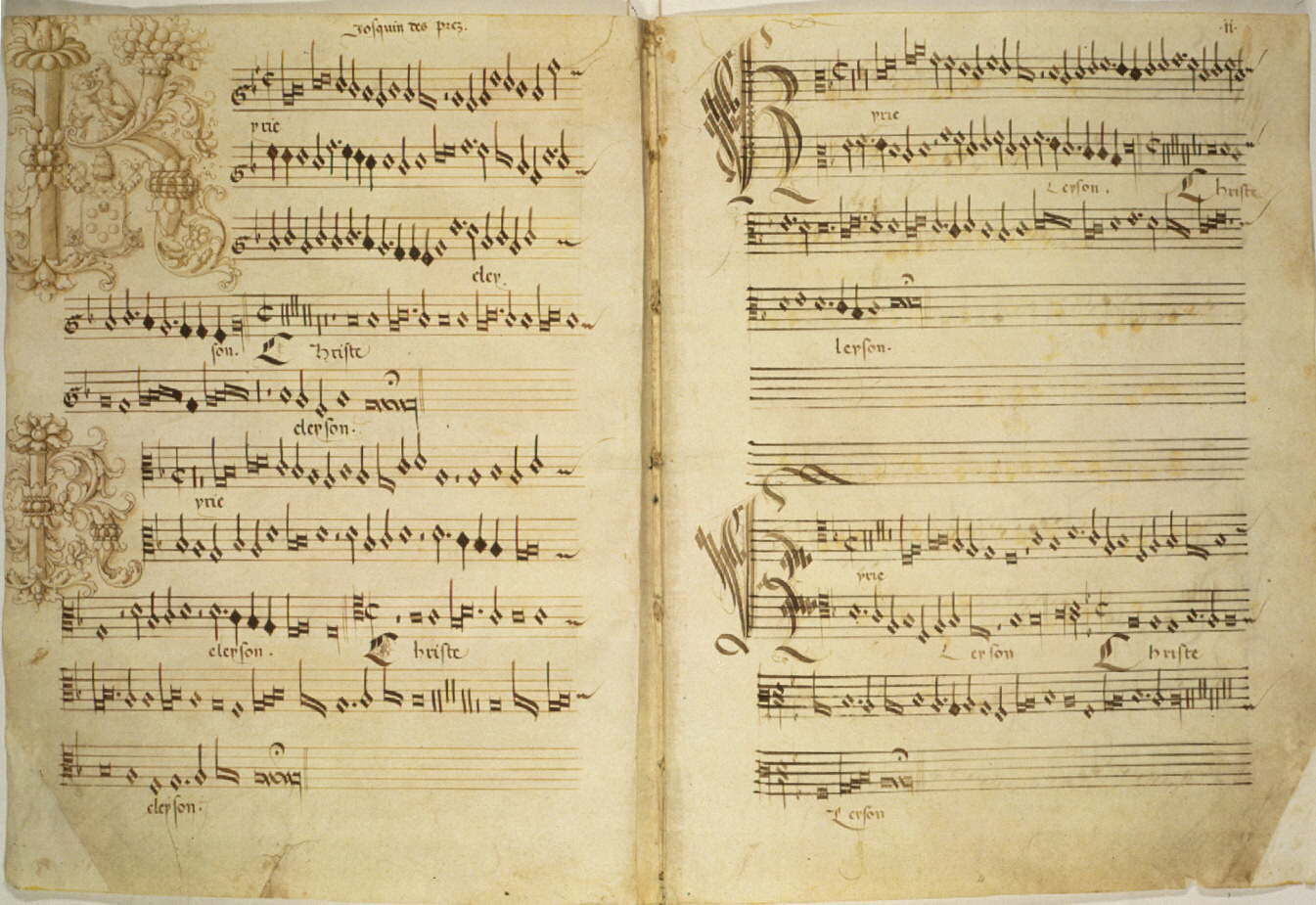
A leading composer of the early Renaissance was Josquin Desprez, who had the brilliant entrepreneurial insight to gain exclusive rights to Petrucci's newly-devised (c. 1500) method of PRINTING MUSIC via printing press (it had taken fifty years after book-printing to finally figure out how to print music, because of the lines AND pitches AND rhythms AND text etc all needing to be aligned, for music printing). Josquin became the first composer to escape the tedium of hand-copying. His deal with Petrucci effectively prevented his competitor-composers from getting "in print," giving him a huge competitive advantage, since people really did buy up his works as quickly as they could be printed, and thus they were spread all over Europe. His fame was such, that even after he died, other composers were still spuriously SIGNING their own works with Josquin's name, in hopes of cashing in on his market share! He died in 1521, and here is the famous quote from a German editor in 1540:
"...now that Josquin is dead, he is putting out more works than when he was alive."
Josquin wrote prolifically in every style that might be marketable, which included sacred works (masses and Latin motets), and pop songs (chansons and frottoles), all in what had become the signature Renaissance style of UNACCOMPANIED 4 or more lines VOCAL POLYPHONY. This renaissance polyphony style far surpassed the medieval polyphony, in complexity and subtlety and scope and range, with lengthy multi-sectional works for three, four, five, or even six DIFFERENT individual voices in different ranges. Typically, no accompaniment and no "chords" were included, and the focus remained on HORIZONTAL interweavings, even as "chords" (to our ears, now) often incidentally resulted (especially in the more playful pop chansons and frottoles).
A look at a modern transcription of his Ave Maria
Well I can't explain the cat in the shirtsleeve, but here isa beautiful-sounding example of a Josquin motet
And here is a fun example of one of his very popular songs, El Grillo,a song "about a cricket" but actually poking fun at a famous singer, saying "that cricket sure is a fine singer but boy does he sing The Same Thing over and over and over again." (my very loose translation) Which of course was all the greater irony as the song caught on all over Europe and got sung around tables from sea to sea, over and over and over again!
So now, to compose "like Josquin" you need to be able to adroitly weave several voices at once, in "round"-like imitative waves, across a wider range, in longer works - but still based on text, and still without (usually) any notated accompaniment, just the weaving lines of text.
"The Consort" - a 1525 painting by "Master of the Female Half-Lengths," depicting the in-home social playing and singing of this polyphonic music.
NUMEROUS fine composers throughout the sixteenth century excelled at this tricky polyphonic trade, having grown up constantly reading polyphonic printed scores, and hearing polyphonic performances at home and in town and at festivals and in church. Wikipedia's Madrigal article can lead you to other composers' names. Those who followed in Josquin's market-driven footsteps produced ever-more sensual and evocative MADRIGALS for a still-buying, still-performing public. Meanwhile, instruments were becoming standardized (thanks in part to "craft guilds"), and a composer could finally write FOR specific instruments (although instrumental playing still often consisted of just playing the lines that had been composed for singing, by whatever instruments were available in the range required).
The height (and last gasp) of the style in SACRED context is Palestrina (c. 1525-1594).
Follow along with modern edition score
Gallery of manuscript images, including Palestrina score
This polyphonic text-setting had developed its own complex "how to" set of compositional rules, which sometimes constitute an entire semester of study and analysis for music conservatory students (the course would be called "16th Century Counterpoint," and might be followed by a semester of "18th Century Counterpoint" focused on inventions and fugues of Bach etc).
This individual and overlapping style, with voices beginning and ending at different times, tended to obscure the text, but since individuals were most often either singing for their own pleasure with the score right in front of them, or else singing long-familiar liturgical texts, clarity of text was not a major issue. Finally the Church demanded greater clarity of the sacred taxts, and certified Palestrina as "clear enough." The best-selling madrigals and motets actually often featured "text painting," that is, the music mimics and exaggerates the text in obvious ways (for example, descending pitches for the phrase "running down the hill" etc.)
Around the time of Palestrina's death, the pop (madrigal) side of Renaissance polyphony had taken a new turn, and it is a most fascinating tiny moment in music history from a marketing standpoint, as one particular duke (Alphonso II of Ferrara) hired (with exclusive rights to everything he wrote) one particular composer (Luzzaschi) and several of the most acrobatically-wide-range singers that money could buy, to create a secret "don't try this at home, just sit and listen (if you're lucky enough to be one of my invited guests)" beyond-amateur-skills heightened sort of madrigal in what became briefly known as a "Concerto Delle Donne" style. Every castle quickly jumped to imitate this. Wikipedie article on Concerto Delle Donne
The "buzz" created by this "secret" music, and the distinction of "professional virtuosos" performing especially difficult madrigals which everyday amateurs could not perform - thus relegating the amazed amateurs to a role as pure "audience" - set up the Turn In The Road that would later become known as The Baroque. "Horizontal" polyphonic thinking gave way to the new "vertical" chord-related single-melody thinking practically overnight. Opera, the multimedia behemoth theater-music-drama-sets-costumes-props lengthy entertainment concoction of the Baroque, built on the cult of virtuoso individual vocalists, funded by the stable wealthy courts, sprang up like dandelions. Well, not as "overnight" as cell-phones, maybe... But amazingly quickly. We will look at the implications of the Baroque and beyond, next week.
we will focus mainly on following up the little patterns and rhythms we began last week, and adding polyphonic ideas.
Typically, in, let's say, a painting class, the whole class might be set up to paint a self-portrait, or a particular still life, each from their own angle. In creative writing, a whole class might be set up to write in a specific form such as a sonnet, or on a specific concept, such as "grief" or "childhood"...
Music composition assignments often center around specific styles or techniques (NOT applicable for this class situation, in my opinion), or around emotional states ("compose grief" "compose elation") which is a valuable exercise especially as an improvisation but is not so interesting to me for this class.
A poem might be used as a starting point, which interests me but I don't have a good poem in mind - any ideas for a great poem, that classmates could either text-set for voices or use as instigation for instrumental music (a la "Prelude to The Afternoon of a Faun" which was after a poem by Mallarme)? Should we each go choose our own poems individually, but all choose poems?
Composer Michael Torke built his first success on COLORS, should we settle on a color? or each choose our own color? Torke's were "Ecstatic Orange" and "Bright Blue Music" etc compositions for orchestra.
We can certainly use any sort of set-up, but I do think it will be most fun to choose SOME focus or limitation, rather than just saying "Ok now go home and compose something."
The most intriguing creative set-up that I have recently come across (which I saw in an AARP creative writing article, here is the link to the article), is to condense any ten-year segment of life into just two pages of writing, using only three-word sentences! I personally have not tried this yet, but I immediately IMAGINED trying it, first with my decade of ages 5 to 15, then with 21 to 31... For me, it seems like a provocative and possibly exciting design. I think it could be altered (simplified) to our purposes:
Possible set-up: Working alone or with a classmate, take any stretch of your life (of whatever length - one year, ten years, a day, an instant?) and somehow express it musically, using our available performance forces (see below), in any style, in a piece (either notated or not) lasting four minutes or less.
Our collective potential performing forces (if I took good notes as you were introducing yourselves), include:
- myself on alto VOCALS definitely, and possibly on guitar or piano?
- Jane possibly VOCALS
- John possibly VOCALS
- Bill possibly on PIANO
- Bob definitely DRUMS and possibly jazz piano?
- Leah possibly CELLO and classical PIANO
(if I have missed (or misunderstood) anyone, let me know)
But I think those of you who ae NOT public performers could take advantage of those of us who are, if you want. And we can all write for multiple vocals if we want, for cello if Leah's willing to read what we've written, and for more advanced piano than we can play ourselves if Bill and/or Leah are willing to read for us...
So possible configurations could include things like:
- a performer making up something for themselves, no notation, no other people involved
- a non-performer who is familiar with notation trying to write something for a pianist to read and play
- a pianist conceiving a work for piano, cello, and two voices, memorizing their own part to play but notating parts for the vocalists and cellist to read and play
- two non-performers composing together, writing out something for two unaccompanied singers
- someone who is not fluent with notation OR performance getting together with a performer and verbally or graphically trying to direct them to try various things and choose from among those semi-improvisations to co-create something
ETC...
The article about creative writing (mentioned above) is so interesting to me right now that I will include an excerpt from it, in closing this week's page:
"Take any ten years of your life and reduce them to two pages. Every sentence has to be three words long - not two, not four, but three words long.
You discover there's nowhere to hide in three-word sentences. (Walk by river. Stare at emptiness. Demons still around.) You also discover that you can't include everything, but half of writing is deciding what to leave out.
Learning what to leave out is not the same thing as putting in only what's important. Sometimes it's what you're not saying that gives a piece its shape. And it's surprising what people include. Marriage, divorce, love, sex - yes, there's all of that, but often what takes up precious space is sleeping on grass, or an ancient memory of blue Popsicle juice running down your sticky chin.
When you have those two pages, run your mind over everything the way a safecracker turns the tumblers with sandpapered fingers to feel the clicks. If there is one sentence that hums, or gives off sparks, you've hit the jackpot.
Write another two pages starting right there."